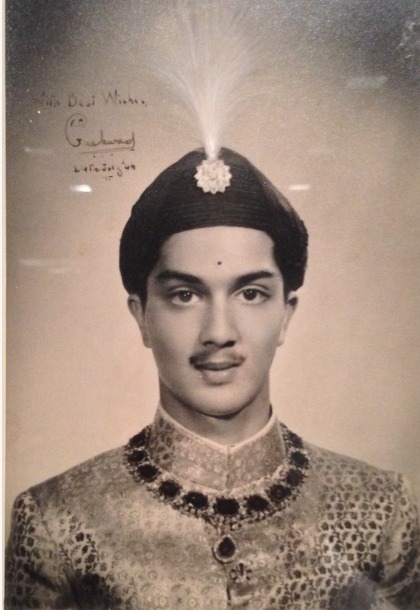

Shrimant Maharaja Fatehsinhrao Pratapsinhrao Gaekwad II
-
Tenure:
1951 - 1988
Profile:
Biography of Maharaja Fatesinghrao Gaekwad (1930 - 1988)
Maharaja Fatesinghrao Gaekwad was born on 2 April 1930 in Baroda as the eldest son of Maharaja Pratapsinhrao Gaekwad, the last ruling Maharaja of Baroda, and Maharani Shantadevi. As the Yuvraj (Crown Prince), he spent his formative years under the influence of his great-grandfather, the legendary reformer Maharaja Sayajirao Gaekwad III, whose ideals of education, art, and public service deeply shaped his outlook.
He received his early education at the Motibaug Prince's School, an institution closely associated with the Gaekwad family and now the site of the Maharaja Fatesingh Museum. Later in life, his contributions to education and culture were recognized when the Maharaja Sayajirao University of Baroda conferred upon him the honorary degree of Doctor of Letters (D.Litt.). He also held the honorary rank of Lieutenant-Colonel of the Baroda Lancers.
Fatesinghrao began his public career as Aide-de-Camp to the Governor-General of India between 1948 and 1949, a role that gave him early insight into the workings of the newly independent nation. Following the accession of Baroda State to the Indian Union, he succeeded as the Titular Maharaja of Baroda in 1951, a position he held with dignity and a deep sense of duty until his passing in 1988.
A man of versatile talent, Maharaja Fatesinghrao entered public life as a parliamentarian, representing Vadodara in the Lok Sabha from 1957 to 1967 and again from 1971 to 1980. He was elected to Gujarat Vidhan Sabha from Sayajigunj constituency. During his tenure, he served as Parliamentary Secretary to the Ministry of Defense and later as Minister of Health, Fisheries, and Jails, where he promoted welfare and development initiatives in Gujarat and beyond.
Beyond politics, he was a visionary industrialist who established the Baroda Rayon Corporation Ltd. in 1956, contributing to the region's economic growth. His deep interest in sports, especially cricket, reflected another dimension of his personality. As a first-class cricketer, he represented Baroda in the Ranji Trophy between 1946 and 1958, later serving as Manager of the Baroda Cricket Association and managing India's cricket tours to England (1959) and Pakistan (1978 - 79, 1982 - 83). Known affectionately in England as "Jackie Baroda," he was respected for his sportsmanship and diplomatic grace. He still holds the record of being the youngest president of the BCCI. He was an expert cricket commentator on radio and was made an honorary member by the MCC.
For over three decades, from 1951 to 1988, Maharaja Fatesinghrao served as Chancellor of the Maharaja Sayajirao University of Baroda, upholding his family's legacy of education and philanthropy. He also chaired the Board of Governors of the National Institute of Sports (1962 - 63), helping shape India's modern sports administration.
He founded the World Wildlife Fund (WWF)-India in 1969 and the Indian Society of Naturalists to save the endangered species of plants and animals and the destruction of natural ecosystems. He was closely involved in establishing the prestigious Delhi Zoological Gardens and chaired the Indian Board of Wildlife's Expert Committee on Zoos. He was instrumental in preserving Chennai's Guindy deer park. In 1985, Maharaja Fatehsinghrao went to participate in the International Wildlife Film Festival at the University of Montana. He was instrumental in making the International Otter Symposium in India. The Library & Documentation Centre, established in 1990 in the WWF-India Secretariat in New Delhi, has been named in Fatehsinghrao's honour as Maharaja Fatehsinghrao Gaekwad Library & Documentation Centre.
A lover of art and architecture, he conceived the idea of the Maharaja Fatesingh Museum in 1958, intending to make the royal art collection accessible to the public. The museum opened its doors in 1961 and remains a living testament to his vision of preserving and sharing cultural heritage. He served as its Chair until he died in 1988.
Maharaja Fatesinghrao was also an accomplished author, writing two notable works - The Palaces of India (1980) and Sayajirao of Baroda: The Prince and the Man (1989). Both books reflect his deep appreciation for history, art, and the legacy of the Gaekwad dynasty.
He passed away in 1988, leaving behind a legacy of intellectual pursuit, cultural patronage, and public service. His life bridged the royal traditions of the past with the democratic aspirations of modern India, and his contributions continue to inspire the people of Baroda and beyond.