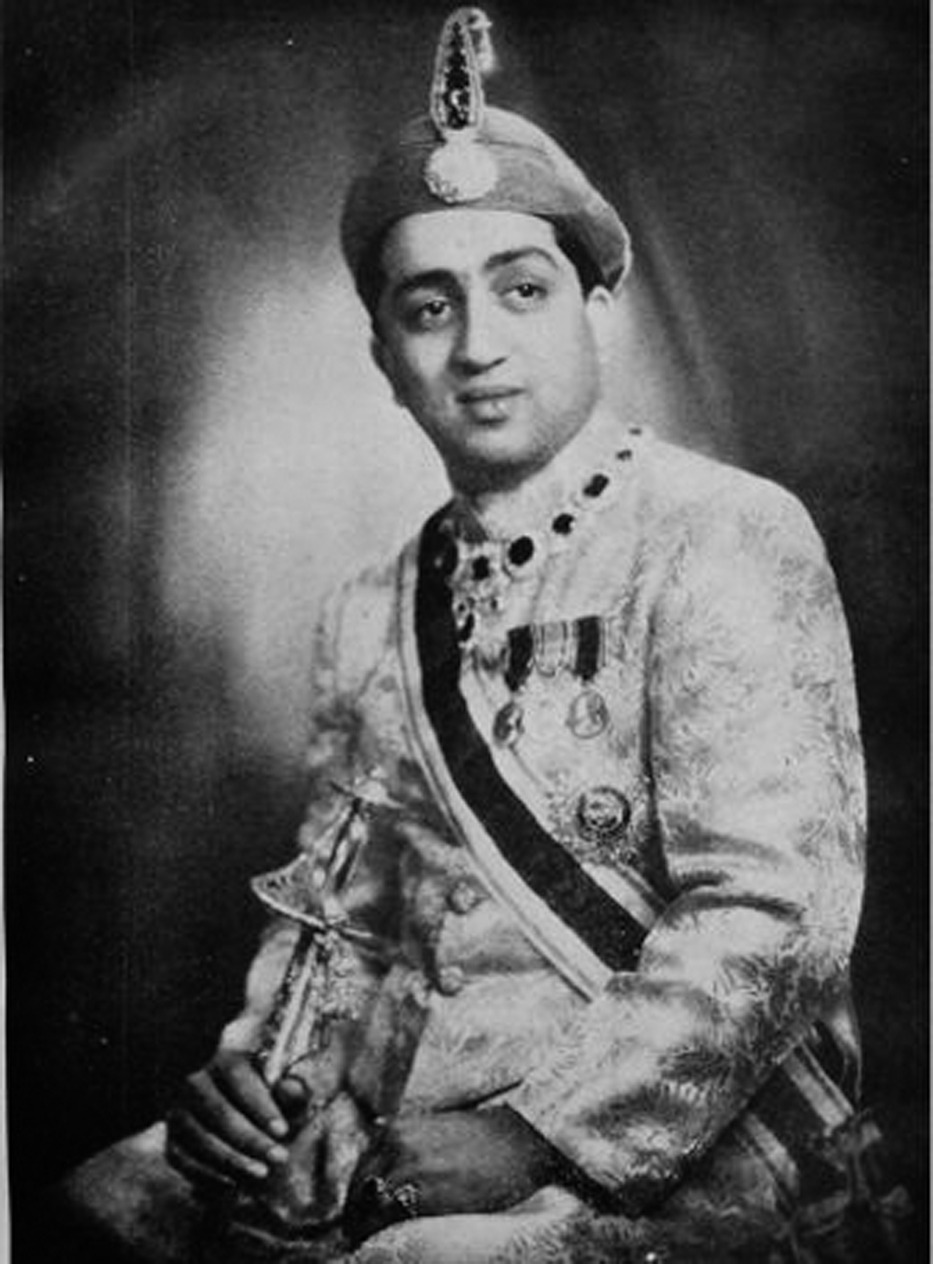

Shrimant Maharaja Pratapsinhrao Gaekwad
-
Tenure:
1949 - 1951
Profile:
Maharaja Pratapsinhrao Gaekwad:
Maharaja Pratapsinhrao Gaekwad was born on June 29, 1908, at the Motibaug Palace in Baroda. He was raised by his illustrious grandparents, Maharaja Sayajirao Gaekwad III and Maharani Chimnabai II. His primary education which began in 1914 was given at the Motibaug School, then called the Princes' School. In 1921, the Prince went to England and joined the preparatory School at Temple Grove in Eastbourne. After a stay of about a year and a half, he returned to India and completed his matriculation in 1926. He passed the First Year Arts examination in 1927 at the Baroda College and then went to Poona to join the Deccan College and obtained his BA LLD degree.
He married Shrimant Shantadevi, daughter of Shri. Mansinhrao Subarao Ghorpade of Hasurkar on 4 January 1929 at the Nazarbag Palace, Baroda.
It was in 1930 that Maharaja Sayajirao Gaekwad III referred to Pratapsinh as 'Yuvraj' at the opening of the Pratappura tank, a feeder to the Sayaji Sarovar (water reservoir). By then, the Prince had established himself as an efficient administrator. Between 1929 and 1930, he worked as Vahivatdar of Baroda Mahal; Personal Naib Suba of Baroda District; Second Class Magistrate of Baroda City and Sar Suba. During his spare time, he went through the files and records of the Political Department and acquired a deep knowledge of its working and the questions that were under consideration at the time.
After the passing of Maharaja Sayajirao Gaekwad III on 6 February 1939, Yuvraj Pratapsinhrao was proclaimed as the Maharaja of Baroda. He was coronated on 26 April 1939. He undertook several initiatives as the Maharaja:
Maharaja Pratapsinhrao went on to establish the Maharaja Sayajirao University of Baroda in 1949, as per the wishes of his grandfather, providing the best education to the people of the Baroda State. He served as the founder and Chancellor of the University between 1949-1951.
In 1949 he created the Sir Sayajirao Diamond Jubilee and Memorial Trust to support the educational needs of the people of the former Baroda State. Baroda Cricket Association.
His love for sports saws the development of Golf, Polo and Cricket in the state. He laid the foundation for what is today the Baroda Cricket Association, Gaekwad Baroda Golf Club, and the Maharaja Pratapsinhrao Coronation Gymkhana. He also sponsored the building of "Gruna baby", India first glider, which was built in Vadodara in 1948.
It was again he who recognized and asserted the importance of Baroda as a cricket playing state and even today Baroda enjoys its independent stature in the Board of Cricket Control of India (BCCI) and legends such as Vijay Hazare, Chandu Borde, Dattajirao Gaekwad, Jaisinghrao Ghorpade, Anshuman Gaekwad, Kiran More among others are products of the Baroda Cricket Association. The Motibaug ground that witnessed some of the most important International matches of the time still stands pristine in the palace estate.
In 1949 he stablished Baroda Medical College. He reportedly took this step after two meritorious students from Baroda were denied direct admission to Grant Medical College in Bombay.
Maharaja Pratapsinhrao also set up the Baroda Broadcasting (radio) Station on 10th January 1947, which is even today remembered for fearlessly broadcasting the banned "Vande Mataram" song as its inaugural telecast.
Maharaja Pratapsinhrao was honoured with Baroda Golden Jubilee Medal-1926; King George V Silver Jubilee Medal-1935; Baroda Diamond Jubilee Medal-1936; King George VI Coronation Medal-1937; Knight Grand Commander of the Order of the Indian Empire (GCIE)-1941 and Indian Independence Medal-1947.
In 1949 Maharaja Pratapsinhrao willingly acceded Baroda state - inarguably the most prosperous and progressive state to form an independent India. He passed away on 19 July 1968 in London. He left behind a legacy for the generations to follow.